WEEK 10

RESEARCH: ECO-FRIENDLY AND ENERGY EFFICIENT GLASS

This is the final week, though research can still be achievable before the exhibition of my project. An idea came to my mind regarding using glass as a way to follow my project main purpose, having ecological, cost-effective, and sustainable ends.

After visiting some websites that talked about Eco-friendly and cost-effective glass that can be used as windows for any kind of residential, I came to the conclusion that the best one for this project is VELFAC.

An specialised type of glass created out of recycled materials with the purpose of limit the human impact on the environment when creating glass.

For more information about the specific aspects about this glass, visit this link: https://velfac.co.uk/domestic/windows-doors/key features/Environmental/

Examples of its design as well as in real life buildings:

VELFAC (2019). Eco windows and doors – Environmentally friendly products. [online] Velfac.co.uk. Available at: https://velfac.co.uk/domestic/windows-doors/keyfeatures/Environmental/ [Accessed 23 Jul. 2019].

WEEK 9

RESEARCH: ECOLOGY AND SUSTAINABILITY AS REASONS TO PRODUCE ECONOMICAL SAVINGS IN AN ARCHITECTURAL BUILDING.

This week’s research will be based on potential ways to improve my “Tiny House” project. I will look for ecological and sustainable aspects that my house can potentially provide so that the customer can get even better benefits in terms of economy.

I have already implemented ecological and sustainable features on my project.

  • Reduced Space House (helps ecologically as it produce savings in terms of materials, space, and also in the impact that a house can cause environmentally).
  • Eco-friendly Cement (ecological material that reduce environmental impact up to a 40% more than normal cement. It can be used as a 3D printing material for the construction of the house)

I will based my research regarding some of my project limitations such as weather conditions, affordability, and location site.

Solar Panels:

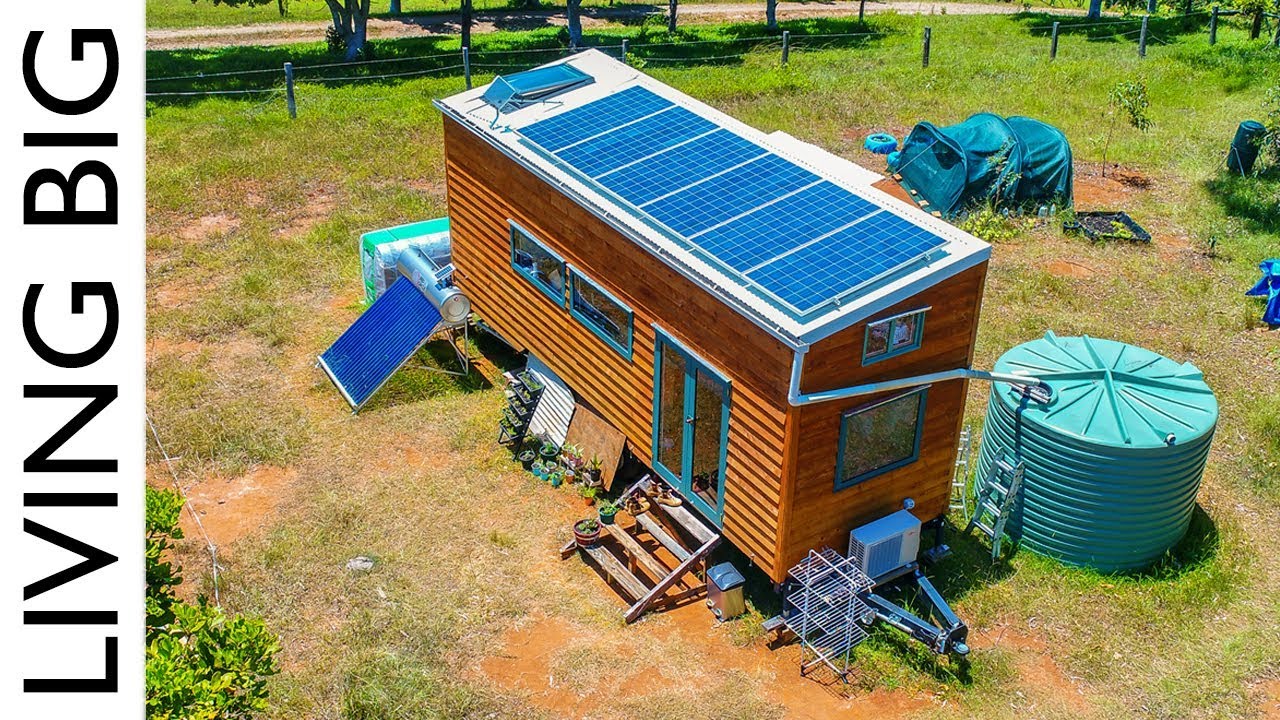
  • Solar panel are geometrical box-like panels which are placed generally in the roof of a building in order to caption sunlight and then transform it into electricity
  • This system uses Photo-voltaic Cells (PV) in order to attract sunlight and then convert it into electricity.
  • They are used as a new ecological and sustainable way to get electricity.

The Energy Saving Trust Limited (2015). What are Solar Panels. [online] Solar Panel. Available at: https://www.energysavingtrust.org.uk/renewable-energy/electricity/solar-panels [Accessed 15 Jul. 2019].

Examples of Solar Panels on Tiny Houses:

VERTICAL GARDENS:

This is a reinvented planting technique to raised vegetation and at the same time save space (influenced by ancient vertical planting methods). Based on the use of a vertical suspended panel that can be either freestanding or attached to a wall. Depending on the dimension of it, the vertical garden can grow form very tiny plants to huge vegetable and fruit plants.

Ambius (2016). What Are Vertical Gardens? | Ambius. [online] Ambius.com. Available at: https://www.ambius.com/green-walls/what-are-vertical-gardens/ [Accessed 15 Jul. 2019].

I have found a basic way in order to create or come up with a vertical garden.

These are the summarize steps:

First: Choose the wall you will have your vertical garden

Second: Build a frame with the dimension of your desire

Third: Attach plastic sheeting and fabric as the foundation of the frame.

Fourth: Set up an irrigation system

Fifth: Add a fertiliser injector and then attach the irrigation system to your water source.

Sixth: Finally choose and then insert the plants into the garden.

Popular Mechanics (n.d.). How to Start a Vertical Garden. [online] Popular Mechanics. Available at: https://www.popularmechanics.com/home/how-to-plans/how-to/g847/how-to-start-a-vertical-garden/ [Accessed 15 Jul. 2019].

Examples of Vertical Gardens in Tiny Houses:

WEEK 8

RESEARCH: OBSERVATIONAL DRAWING TECHNIQUES AND FIRST EXAMPLE.

This are the sources I used to gain more knowledge about how to come up with good observational drawings. Also, the example I will post today was when I had less knowledge about observational than in the present.

Gale, A. (2017). How to Create an excellent Observational Drawing: 11 Tips for High School Art Students. [online] STUDENT ART GUIDE. Available at: https://www.studentartguide.com/articles/realistic-observational-drawings [Accessed 25 Jul. 2019].

EmptyEasel (2015). How to Draw what you See: Techniques and Tips to Improve your Drawing Skills – EmptyEasel.com. [online] EmptyEasel.com. Available at: https://emptyeasel.com/2006/11/24/how-to-draw-what-you-see-techniques-and-tips-to-improve-your-drawing-skills/ [Accessed 25 Jul. 2019]

Pal, S. (2015). 15 observational drawing tips. [online] Creative Bloq. Available at: https://www.creativebloq.com/advice/15-observational-drawing-tips [Accessed 12 Jul. 2019].

Themodmin, 2017. Rapid sketching – Architecture Daily Sketches. [Online] Available at: https://www.youtube.com/watch?v=5LbUwkk93QI [Accessed 12 July 2019].

Yanconsky, L., 2016. How to Accurately Observe and Draw Objects. [Online] Available at: https://www.youtube.com/watch?v=TOtKnMN-VNs [Accessed 12 July 2019].

Tip 1

  • Make sure a light source is going directly towards the object you trying to draw.

Tip 2

  • Observe carefully at what you are trying to draw.

Tip 3

  • Use a viewfinder to stablish the edges of the drawing.

Tip 4

  • Use the perspective and then start drawing the lines from the edges of the viewfinder.

Tip 5

  • Use your pencil or another straight other to check for the angles of the object you are drawing.

Tip 6

  • Use basic forms, gridlines, lines, and other elements to stablished the general draft of the building before coming up with any details.

Tip 7

  • Look to your real object as much as you look at your paper, otherwise you will think you will draw what you think you see and not what you really see.

Tip 8

  • Shade the image from darkest to brighter and have a good range of tones inside the drawing.

Tip 9

  • Use hatching and mark making methods to convey surface and texture to the drawing.

Tip 10

  • Erase, add, or omit details if necessary in order to give your own personal style to the drawing.

MY EXAMPLE BEFORE RESEARCH: (2 hours drawing)

WEEK 7

RESEARCH: HOW TO DO A FLOOR PLAN (DRAWING).

My project is looking better after every week. This week my main objective is to come up with different ideas of floor plans for the tiny house I am designing. Then after doing those four ideas I will have to pick the best one and draw a very precise and detailed floor plan.

Since I have no experience on how to draw floor plans, I had to do a research about it. Here are the sites and books I used for my research:

Bielefeld, B. & Skiba, I., 2009. Basics Technical Drawing. 2nd ed. Basel – Boston – Berlin: Birkhauser Verlag AG.

On, A. M., 2017. How to render a floor plan by hand | MARKERS. [Online]
Available at: https://www.youtube.com/watch?v=ZtJhTmxojTY
[Accessed 04 July 2019].

ProfDrafting, 2015. How to Sketch a Floor Plan. [Online]
Available at: https://www.youtube.com/watch?v=O5A58npxsps
[Accessed 04 July 2019].

Property, E., 2017. How to draw a floor plan. [Online]
Available at: https://elementsproperty.co.uk/floorplans/how-to-draw-a-floorplan/
[Accessed 04 July 2019].

Sketcher, R., n.d. Draw Floor Plans. [Online]
Available at: https://www.roomsketcher.com/features/draw-floor-plans/
[Accessed 04 July 2019].

SmartDraw, n.d. Floor Plan. [Online]
Available at: https://www.smartdraw.com/floor-plan/
[Accessed 04 July 2019].

Workshop, 3. D., 2017. Floor Plan Design Tutorial. [Online]
Available at: https://www.youtube.com/watch?v=R7YxG4nsqeg
[Accessed 04 July 2019].

After the research , here are the main points (for me) in order to draw a detailed and accurate floor plan:

  1. Think about different options when it comes to the interior.
  2. Pick the best one
  3. Have all the dimensions and maths ready.
  4. Draw everything from the outside to the inside.
  5. Start with the walls in the exterior to the ones in the interior.
  6. Add basic architectural features.
  7. Add Furniture if necessary.
  8. Render the whole drawing (colours, fine liners, markers, etc.)

WEEK 6

RESEARCH: STEPS TO DO AN ARCHITECTURAL 3D MODEL.

The sites I used in order to have a wide knowledge about this issue presented in my project are:

Arch2o, 2016. How to Make An Impressive Architecture Model? Your complete guide. [Online]
Available at: https://www.arch2o.com/architecture-model-complete-guide/
[Accessed 28 June 2019].

Cenhiroshi Art, 2017. How to Make an Architectural Model by Hands?. [Online]
Available at: https://www.instructables.com/id/How-to-make-an-Architectural-Model-by-hands/
[Accessed 28 June 2019].

First in Architecture, 2017. Architectural Model Making – The Guide. [Online]
Available at: https://www.firstinarchitecture.co.uk/architectural-model-making-the-guide/
[Accessed 28 June 2019].

Pereira, M., 2018. The Best Materials for Architectural Models. [Online]
Available at: https://www.archdaily.com/904379/best-materials-for-architectural-models
[Accessed 28 June 2019].

Zilliacus, A., 2016. 16 Tips To Improve Your Model-Making Skills. [Online]
Available at: https://www.archdaily.com/799474/16-tips-to-improve-your-model-making-skills
[Accessed 28 June 2019].

MODEL MAKING

The first things when it comes to create a 3D Model are the amount of time it will take the artist to finish it, the degree of patience it requires from the artist, and finally how concentrated the artist have in order to come with a desirable result.

FIRST STEP: THINK OF AN IDEA

In this case, I have been drawing rough sketches and illustrating ideas on how my tiny house will be. Now I have to decide between all of my ideas. Pick the one with the more potential of becoming reality, always taking into account the constraints that I have

SECOND STEP: BE PREPARED FOR THE PHYSICAL WORK

Now that the idea has been already chosen, the next part is having all the necessary materials and tools so that the specific task can be met without additional issues. Prepared your required materials and write them down on a list so that after you can buy them either online or an art store.

Measurements/Rulers

  • Architectural Scale (Define your model scale and calculate dimensions.)
  • 6’’, 12’’, and 18’’ rulers (Depending on the size of model.)
  • Triangular Rule (Plan and section drawing, glue vertically, etc.)

Pens

  • Sharp Pencil (Using for make marks and any draft drawing. Size 2B is recommended.)
  • Double-side Marker: Fine and Ultra-fine (Useful when you draw plan and section.)
  • Micron 01, 03, and 08 (Different line weight for drawing.)
  • Thick Marker (Hard line weight in drawing such as wall and columns.)

Cutting Tool

  • X-acto Knife (Useful when cut detailed and small pieces of model parts.)
  • Utility Knife (Useful when cut relatively large and thick pieces of model parts.)
  • Ciser (Rough cut only.)

Cutting Mat

  • OLFA or ALVIN Cutting Mat (Anti-skidding and be able to protect table from cutting knives.)

Glues

  • Rubber Cement (Good glue for stick paper and paper)
  • Quick Dry Tacky Glue (Good at most of paper and some wood materials.)
  • Glue Gun (Extremely quick dry glue with high temperature injector.)
  • Stickers or Tape (Using for fasten the drawing paper on table.)

Board materials

  • Thin Black and White Foam Board (Beginner’s main building materials)
  • Thick Black and White Foam Board (Mainly use for basement or landscape of your model.)
  • Chip Board (Brown hard paper)
  • Thin Plywood (Need to be able to cut.)
  • Clear Sheet Print (Pretend as glass.)

(Cenhiroshi Co., 2017)

STEP THREE: AWARENESS OF POTENTIAL DAMAGE TOOLS CAN CAUSE.

Most of the tools artists use when creating a 3D Model can turn out to be quite dangerous, the scalpel, knife, and glue gun for instance. While using tools that can be of potential damage please make sure to first be aware of it and then try to be careful while using them. Location of the tool is essential if the artist wants to prevent unexpected accidents while creating the 3D Model.

Things like bandages and alcohol or other disinfectants are needed for accidents.

STEP FOUR: SELECT A SCALE OF YOUR MODEL

This step is straightforward as the artist’s next step is to decide between the variety of scales in which a model could be made. The artist have to choose a scale, therefore deciding how big or small their model will be. After picking the scale, all the process of the model have to follow the scale.

STEP FIVE : FLOOR PLAN AND SECTION CUT DRAWING

Floor plans and section cut drawings are needed along the main 3D model in order to better communicate the idea of my design. The main important things in this step are that the artist has to choose a scale, draw a basic plan view (tracing paper or a piece of paper). Calculate dimension like the width, thickness and angle. Is there in this part of the model making process where your concentration is being fully tested. A quite helpful advice is to write down everything in relation to numbers and calculations.

STEP SIX: DIMENSIONS TO DRAWINGS

This step is recommendable before the start of your model making process. Writing down the dimensions of your drawings helps you make the word in a faster and more precise way.

STEP SEVEN: START MAKING THE MODEL

Now the artist can start the process of model making. Now that your materials are ready to be cut just grab the scalpel or a sharp knife in order to make clean cuts. It is suggested to use a triangular or square ruler when gluing two pieces together so they can fit perfectly with each other. Try to put your final pieces above the floor plan so you can see if they match perfectly with the drawing.

STEP EIGHT: INTERIOR AND STRUCTURAL MODEL

Create the interior design of your architectural model and then come up with the structural model (exterior design of the house). In summary, it is better sometimes to create two models: one showing the interior and the other one showing the exterior

STEP NINE: COLOURS AND TEXTURES

Final details have to be done after coming up with the structural matters. Colours, details, and textures will have to be done at last. Then the 3D Model will be finally done.

ANALYSIS: INITIAL SKETCHES GROUP CRITIQUE

Sketches, ideas, and drawings are being made this week. My classmates and I have started the part of the project called “Ideas development”. This part of the project always comes after having an extensive knowledge of what you will be doing in your project. In order to develop an Architectural project you first have to look up for the basics to then narrow it down until you have a clear idea of the design you will want to come up with.

In my case, my classmates along with my tutor had a look at my drawings to see whether they were attractive from their perspective. After a thorough analysis of all my drawings, they said all the drawings were fine. However, one things they also mentioned was the lack of curved, moving-type of buildings. (I had just 3 buildings with curves and movement expression and about 9 were very geometrically design).

They suggested me to come up with more curved design even though one of my main constraints in the project is affordability. By designing more curved buildings I will have a wider vision of how can be the best possibility in order to outweigh the problems presented in my project. It also can boost my imagination so that in the future I can think of more ways to develop my ideas.

Finally, my tutor suggested me to start thinking about materials and textures in terms of building exterior and interior. This means, start to apply colours and texturing techniques so the viewer can have a much clearer idea of what I am intended to show.

The future aspects I have to think about so far are:

  • Curved architectural drawings.
  • Colour and texturing techniques on drawings.
  • Exterior and interior design of the house.

RESEARCH: TIPS AND INSPIRATION FROM SECONDARY SOURCES

Books Source:

Architectural Drawing by David Bernie (2010)

Drawing Skills in Architecture by Tim McGinty (2010)

Small ECO Houses: Living Green In Style by Cristina Paredes and Alex Sanchez Vidiella (2010)

These sources helped me understand various issues I had about my project. They also helped me find inspiration of new concepts and ideas for my future design.

  • Lack of ideas and inspiration for my future design.
  • A limitation of drawing, sketching, and rendering skills.
  • No skills on model making.

In this slideshow I gathered four of the most important features of sketching I have to learn in order to clearly express my purpose through concepts and designs.

  • Building Materials
  • Building Curves
  • Vegetation
  • Building Shading

After looking for drawing, sketching, and rendering techniques (strictly Architecture) I went to look for a book with examples on small houses form over the world. Here is what I found.

WEEK 3

RESEARCH AND INSPIRATION: B.ARCH AND M.ARCH DEGREE SHOW

I went to the B.Arch and M.Arch Degree Show 2019 to take pictures and try to get some inspiration from the projects presented. Here are what I consider the best projects from the general Degree Show.

This first project captivated me because of two main reasons:

The student came up with the design of a two block building in which he used cantilever roof along with a repetition of thin white columns in order to show beauty and attractiveness. The building appeared to be large and strong thanks to this facade. The materials the student implemented on this project where concrete, timber and glass. Three essential materials of my favourite at movement, Modernism. By observing the building external composition I could noticed how the combination of materials can give the building an unique look.

The reason I chose this project as a research part of mine was because of the inspiration it gave me in terms of model making. This project’s model was minimalist, functional, but somehow quite attractive. The material the student used (light brown foam-board) was essential to understand the nature of the project. Plus, it was a clear representation of the simplicity and functionality of they design.

This picture I took form the student project was of great help because I could see the steps an Architecture student has to take in order to come up with a final concept when designing. Now I understand most of the time a design comes from inspiration. It could be anything, an object, shape, texture, city, even a painting. Then, there is the research part so that the student can find several potential ways to solve a problem through designing. Finally, the student has to use their imagination and creativity through a final concept, therefore having an answer for the task settled.

Colour is the main word for how can I best define the reason I chose this project. I find light brownish colours very attractive when used on buildings due to the history behind this colour. I relate this colour and its derivatives with ancient but beautiful buildings like the Roman Colosseum or the Pyramids of Giza. Due to the source of inspiration the student used (Venice, Italy) the exterior of the building has those types of colours. This is because Italian Architecture is one of the oldest so building are usually made out of sandstone or materials with this brownish colour style.

What caught my eyes on this model was the way it as arranged and the size of the different buildings.

Arrangement of housing is one thing I need to know about for my actual project, therefore I can tell that by looking at this model I now have a creative and unusual way of how to settle my house arrangement. However, there are specific parameters I have to look up within this type of arrangement.

The other eye catching feature of this model is how small are the houses. This is essential for my project as it is about creating an affordable residential space for a single person. Here I can have an inspiration on size and design of small houses.


RESEARCH: SMALL HOUSES – LINKS TO VIDEOS AND WRITTEN SOURCES

Here is a list of almost all the sources I used for my research about Small Houses:

Videos:

Written Sources: